Which Industries Actually Make Money? Semiconductors and Entertainment Software Lead the Margin Race. Premieur
Follow
Sector • Industry
Which Industries Actually Make Money? Semiconductors and Entertainment Software Lead the Margin Race
Industry economics can make a substantial difference to profitability. January 2026 data from NYU Stern reveals a wide gap between the most profitable and loss-making sectors among…
Argya Whisnuputra Oct 26, 2026 2 min read
Follow Premieur
Industry economics can make a substantial difference to profitability. January 2026 data from NYU Stern reveals a wide gap between the most profitable and loss-making sectors among US-listed companies.
Semiconductors Take the Lead
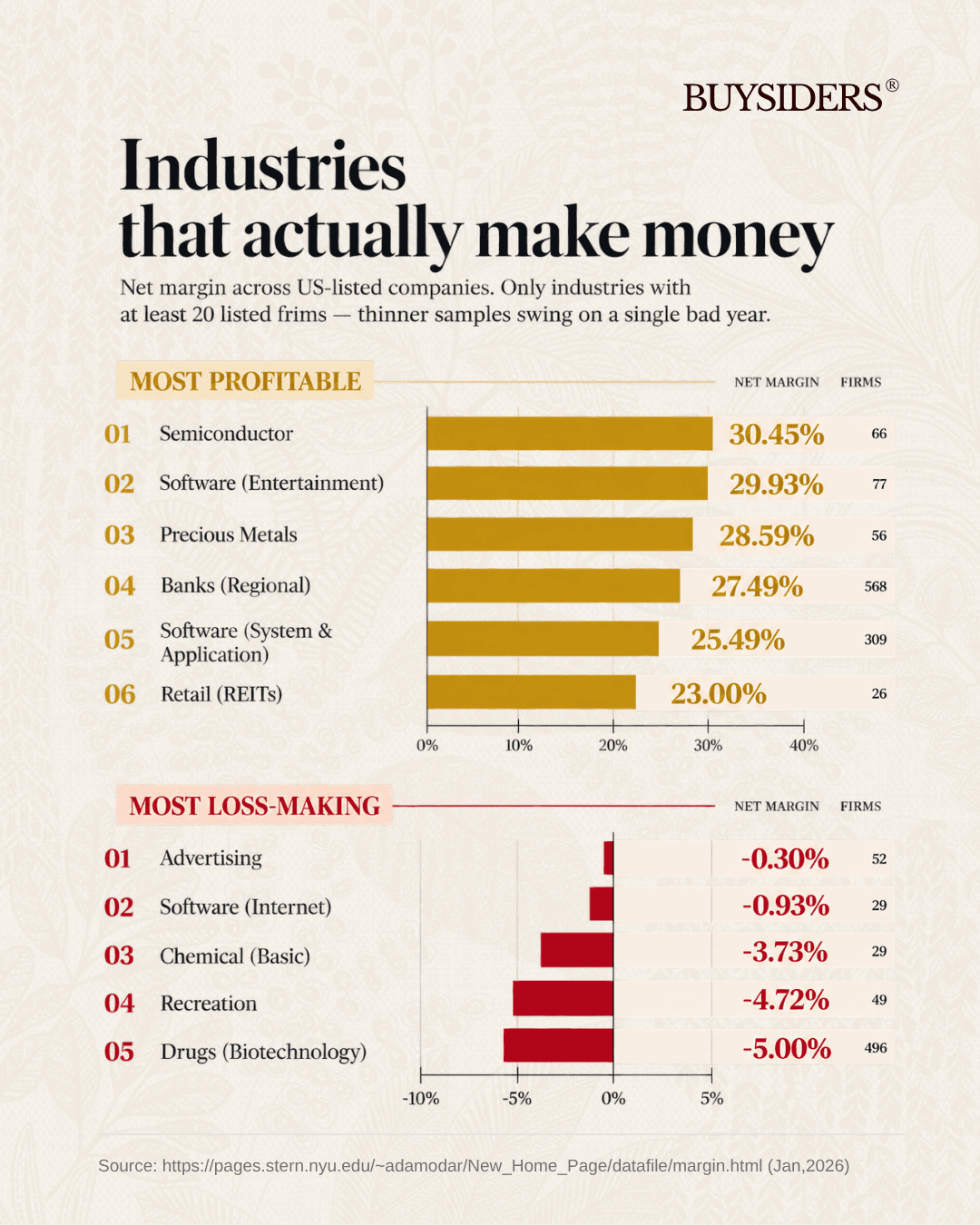
Semiconductors rank first, with a net profit margin of 30.45% across 66 listed companies. In other words, the industry generates approximately $30.45 in net profit for every $100 of revenue, based on the reported aggregate industry margin.
Entertainment software follows at 29.93%, based on 77 firms. Digital products can benefit from scalable distribution: once a game or software product has been developed, additional sales may require relatively little incremental production expenditure.
However, development costs, marketing, platform fees, and unsuccessful releases can materially affect individual companies. Strong industry margins do not guarantee that every business will achieve comparable results.
Precious metals rank third at 28.59%, followed by regional banks at 27.49%. System and application software records a 25.49% margin, while retail real estate investment trusts (REITs) post 23.00%.
These results illustrate that attractive profitability can emerge from different business models, including technology, financial services, commodities, and property ownership.
The Other End of the Ranking
The picture changes considerably among the five industries with the weakest reported margins.
Biotechnology drugs record a net margin of -5.00% across 496 firms. Recreation follows at -4.72%, while basic chemicals report -3.73%. Internet software posts -0.93%, and advertising records -0.30%.
Negative margins indicate that, on the reported measure, expenses exceed profits. In biotechnology, companies may incur substantial research and development costs before commercializing successful products. Recreation businesses can face high fixed costs, while chemical producers may be exposed to commodity prices, energy expenses, and cyclical demand.
These figures should not be interpreted as proof that every company in these industries is unprofitable. Industry averages can conceal major differences between established market leaders and smaller businesses.
What Investors Should Take Away
Net margin measures the proportion of revenue remaining as net income after expenses, interest, and taxes. It offers a useful starting point for comparing industry profitability, but it does not measure cash generation, growth potential, or returns on invested capital.
A business with a high margin can still be a poor investment if it requires excessive capital or trades at an unjustifiable valuation. Conversely, a lower-margin business can create substantial shareholder value when it generates reliable cash flows and reinvests capital effectively.
For investors and business builders, the objective is not simply to identify the highest-margin industry. It is to understand why the margin exists, whether it can persist, and how much capital is required to sustain it.
Source: Aswath Damodaran, NYU Stern, industry margin data as of January 2026. Original dataset.


Comments